Do You Speak Attic Greek? (2025 English Edition)
Learn to speak Ancient Greek with Aristophanes and other Attic writers:
Do You Speak Attic Greek?
⸻ ⸻ ◈ ⸻ ⸻
Modern conversation
using Ancient Greek colloquialisms
according to the best Attic Greek authors
by E. Joannides, Ph.D.
Fully Translated to English
This book is a full English translation of the famous old German & Ancient Greek conversational phrasebook called "Sprechen Sie Attisch?". It's a phrasebook for students of Ancient Greek who would like to speak in the Attic Greek dialect used by classical authors such as Aristophanes, Plato and Sophocles.
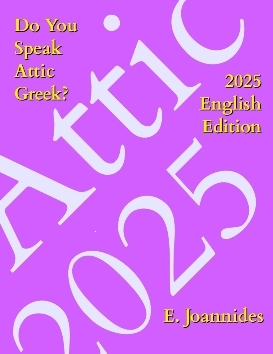
Eduard Johnson’s collection of everyday Attic Greek phrases is erudite but also playful, humorous, and inventive. Many of the phrases are adapted directly from Attic Greek plays by Aristophanes and other ancient authors. The introductory notes contain insights and tips for students of Greek grammar and idiom. In the preface, Johnson asserts the vital importance of using Ancient Greek in colloquial dialogues, first, as the foundation for true mastery of the language.
This book was written by Johnson under the pseudonym E. Joannides in 1889 and revised in 1902, 1912 and 1922. It was translated into English in 2011 and 2025 by several contributors, and released to the public under a share-alike license: CC BY-SA 4.0.

Johnson’s Preface and introductory Small Rules and Observations contain valuable insights about Greek grammar and idiom. They are worth reading with careful attention. We are pleased to make them readable to a wider audience.
We added a few new items: an About the Author section briefly introducing Johnson; and many footnotes with clarifying comments or references to specific sources. Aristophanes was the favorite source. Most of the footnotes are specifically for the benefit of inexperienced classicists or independent learners who are working without the help of any teacher or classmates.
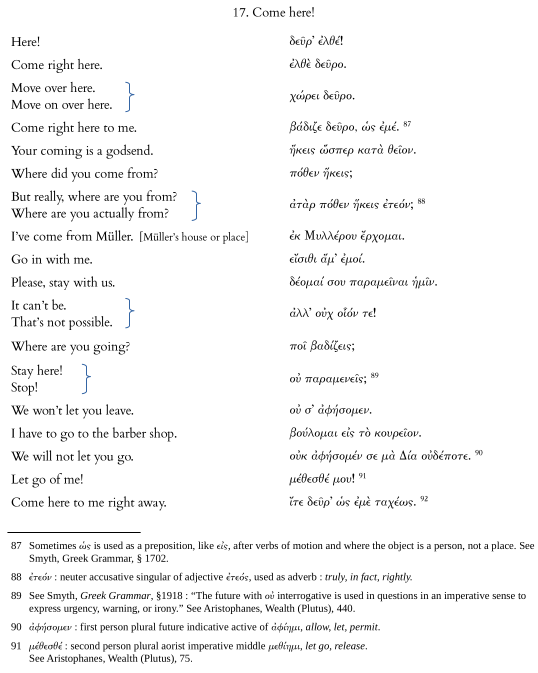
Sample Chapter 17: Come here!
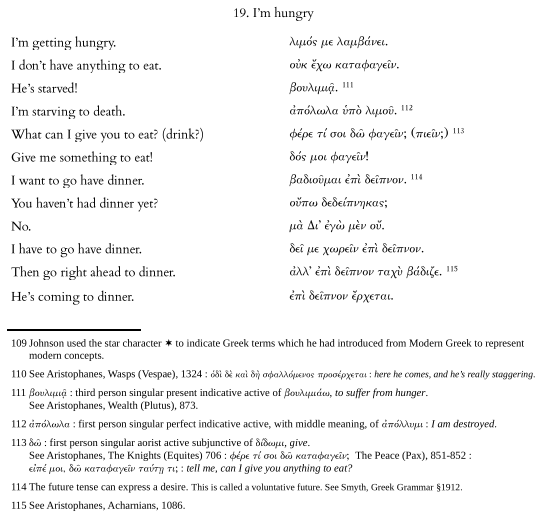
Sample Chapter 19: I'm hungry
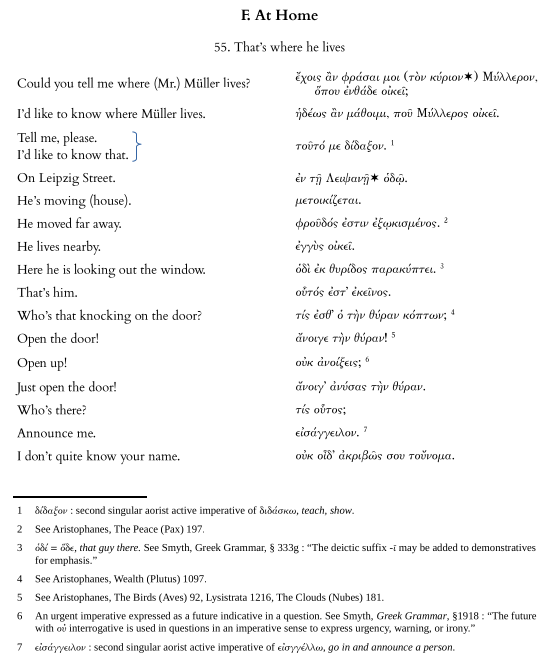
Sample Chapter 55: That's where he lives
Contemporary Reviews (1889 ff.)
The following review comments appeared after the first edition of this book:
“This little opus demonstrates that it is actually possible to express oneself in Greek using the knowledge acquired at Gymnasium [university-track secondary school]. The preface contains small rules that are very useful in practice.”
—Gazette for Bavarian Gymnasium Education
[Blätter für bayer. Gymnasialshulwesen]
“We must accredit to the author a deep familiarity with the genius of Greek idiom. Having mastered both classical and vernacular experssions, he understands how to dress up in fine Greek garb modern culture’s artistic terms as well as everyday expressions.
—Prof. Dr. Krieg-Freiburg in Literary Review [Litterar. Rundschau]
“A really charming little book that will certainly attract many fans.”
—Journal for Austrian Gymnasien
[Zeitschr. f. d. österr. Gymnasien]
“The author has come up with a terrific idea. It will be highly beneficial for Greek language instruction.”
—Berliner Philological Weekly
[Berliner philolog. Wochenschrift]
“I recommend this excellent book to all audiences, no less for careful reading than for its warm humor.”
—State Council Professor Dr. Ernst Koch, Moscow, in the foreword to the 13th edition of his Greek Grammar for Schools [Griechische Schulgrammatik]
“It’s a really nice idea that underlies this book. The author will doubtlessly earn praise and thanks from far and wide. Truly, he has perfectly mastered Ancient Greek. In the introduction he wisely provides a great deal of useful tips and rules.”
—Literary Central Gazette
[Litterar. Centralblatt]
Printed Editions
-
TBD (Coming soon)
[Placeholder text]
-
TBD
[Placeholder text]
Online Editions
-
TBD (Coming Soon)
[Placeholder text]
⸺ ⸺ Ridentem discere Graeca
Quid vetat? ⸺ ⸺

Readers can send corrections and comments to hypothekai@aristophanic.com.