Editions & Author Comments
Below we list details of every edition of Johnson's book, with translated excerpts from the Forward section of each edition, if any.
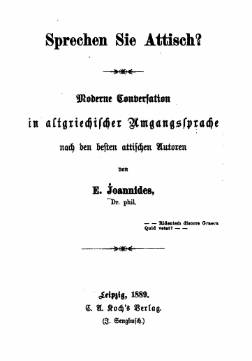
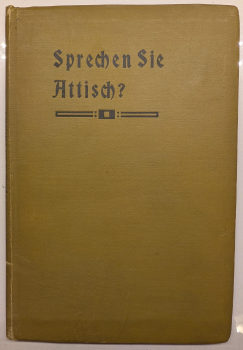
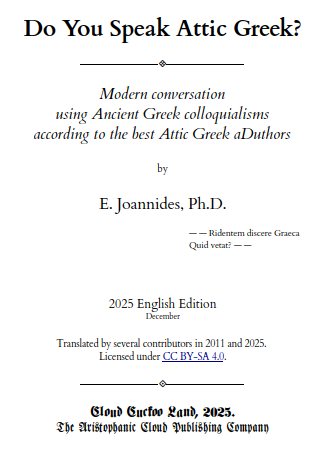
Sprechen Sie Attisch?
⸻ ⸻ ◈ ⸻ ⸻
Moderne Conversation
in altgriechischer Umgangssprache
nach den besten attischen Autoren
von E. Joannides, Dr. phil.
1889, First Edition:
Leipzig: C.A. Koch’s Verlagsbuchhandlung (J. Sengbusch), 1889.
From the Preface:
Nearly everyone considers Greek to be a fundamentally unlearnable language, never to be wielded as easily as a modern language, which one masters tolerably well. This present little book, which owes its origin to a merry holiday mood, should provide evidence to the contrary, as it makes a first attempt to teach Attic colloquial speech in its most useful expressions.
 A person who knows the everyday language of a country holds the key to understanding that country’s literary works and the people themselves.
An Attic schoolboy brought to his reading of Greek poets the same thing an Attic farmer carried into the theatre or the assembly: only their knowledge of Attic colloquialisms in their simplest forms. This knowledge enabled them to understand Sophoclean drama and Periclean oratory. The language of everyday life supplied the analogies needed to comprehend loftier works of speech and writing.
It has often been claimed that surprisingly few words and expressions are needed to allow the common man to get by in his mother tongue and to understand matters that for him are novel. Shouldn’t it be possible to tease out the comparatively small original Athenian word-stock, grasp the language at its core, and make those words and expressions familiar once more, for all who want to really learn Greek?
Aristophanes offers plenty of verbal material for this purpose in those bits where he lets the common man speak in a folksy manner. Elsewhere in literature, one finds scattered passages which must represent true depictions of the speech of ordinary life. So this task cannot be unsolvable, even if the writings available to us provide only a small contribution to the solution.
The words and expressions in the dialogues below have been adopted mostly from Aristophanic speech. ...
The most common words and expressions in the lingua franca of everyday life constitute the original material, the nucleus of crystallization, on which and around which further speech formation begins and agglomerates. For this reason alone they deserve our attention. Here is the place to grasp the language, for those who really want to learn it.
Erasmus and his contemporaries, whose knowledge of Greek we admire, learned it from interactions with Greek-speaking teachers via conversations about objects in ordinary life. Nobody has ever really learned Greek purely from grammar and reading. The language deserves learners who truly learn it, rather than settling for the mere appearance of knowledge (From the Preface, Sprechen Sie Attisch?, 1889).
1902, Second Edition:
Zweite Auflage. Dresden and Leipzig: C.A. Koch’s Verlagsbuchhandlung (H. Ehlers), 1902.
Foreward:
The second edition offers many additions to the first, as well as some citations for Greek phrases, here and there, where it seemed desirable.
Where possible, the author has considered requests made in many gracious conversations about this modest little book, to soften the German expressions in the section titled A Grand. However, here we have adopted the German terms unchanged from the Munich periodical Fliegende Blätter for the specific purpose of demonstrating that with just a small vocabulary of Attic colloquialisms, one can manage quite well even on what seems the most difficult soil.
It goes without saying that this little book presumes that the readers have already, at minimum, familiarized themselves with Greek word forms.
Plauen, Germany, end of 1901. Dr. J.
1912, Third Edition:
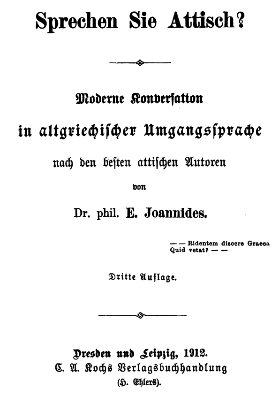
Dritte Auflage. Dresden and Leipzig: C.A. Koch’s Verlagsbuchhandlung (H. Ehlers), 1912.
Foreward:
The third edition is substantially an unchanged reprint of the previous one. A few obvious oversights and printing errors have been corrected. We did not believe it appropriate to make more comprehensive changes to this small volume, as the author has since passed away.
1922, Fourth Edition:
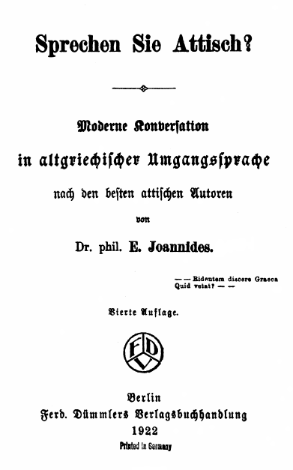
Vierte Auflage. Berlin: Ferd. Dümmlers Verlagsbuchhandlung, 1922.
English Editions
We are pleased to make Eduard Johnson's insights readable to a wider audience, in the English-speaking world.
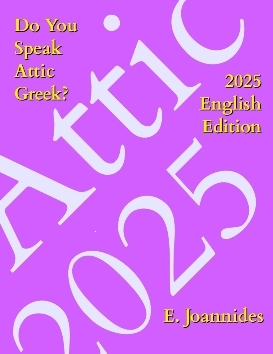
2025 English Edition:
Aristophanic Cloud Publishing Company
ISBN: 979-8-90030-048-1
From the Translator's Note:
This book is a faithful translation of the author’s German work. We had a few goals:
- For all example Greek phrases, provide idiomatic phrases in today’s English.
- Faithfully translate the German texts into today’s English.
- Fix any errors that are obvious and unambiguous.
- Otherwise, preserve the book as-is, as an artifact created by Dr. Eduard Johnson for a nineteenth-century audience: It is learned but also playful, humorous, and inventive.
In some places, this translation produces some odd anachronisms and clashes of style and perspective. Johnson’s example phrases are set in the context of life in Saxony in 1880s and 1890s. Our goals were to preserve Johnson’s tone and perspective, and to make his notes available to today’s English-speaking learners. We resisted the temptation to modernize or expand the book. For example, we preserved all example phrases, including those referring to Leipzig or to the German currency unit, the mark. We translated Herr Müller as Mr. Müller, and not Mr. Miller.
On the other hand, we freely used today’s English idioms. This approach creates mismatches, but then again, any comparison between a modern language and Attic Greek is already a mismatch and an anachronism. What year is it? 2025? 1889? 414 BC? Not sure. Have fun with the book! (From: Translator's Note, 2025.)
...
From the Foreward to the English Edition:
In recent years, the selection of books dedicated to learning spoken Ancient Greek has increased in quality and quantity. While enjoying that new wealth, we should not overlook this small gem of a book from 1889 and revised in 1902.
Dr. Johnson had a fine sense of what needs to be taught. He did not list one way to say “I don’t know” (οὐκ οἶδα), instead he devoted an entire page to the topic, with variations on ways to assert, enquire or speculate about knowledge.
 A good phrasebook should include phrases that are tentative or deliberative or emotionally loaded. Johnson’s dialogs cover a range of situations, intentions and emotions that are situationally specific yet still universal. Nearly any human, ancient or modern, will eventually need to find the words to say, “we will find out,” or “you can’t trust that guy,” or “I’d appreciate you doing that for me.” The chapter headings reveal Johnson’s excellent instincts: 3. Are you okay?, 16. Wait!, 30. Praise and blame. The chapter titled 38. At the tailor may be less interesting today, but 22. Late to school and 48. Should I? are timeless topics.
Like Aristophanes, many of Johnson’s dialogs are funny or irreverent. He declared this openly, on his title page: Ridentem discere Graeca quid vetat : “What prevents one from learning Greek with a laugh?”
A translator may be tempted to expand this book by adding new vocabulary, such as words related to computers or air travel. We have elected to treat Dr. Johnson’s book as an artifact worth preserving. With only a handful of exceptions, this edition lists exactly the same Greek phrases as the second, third and fourth editions, which were identical except for a few corrections (From: Foreward to the English Edition, 2025).
Printed Editions
-
TBD (Coming soon)
[Placeholder text]
-
TBD
[Placeholder text]
Online Editions
-
TBD (Coming Soon)
[Placeholder text]
⸺ ⸺ Ridentem discere Graeca
Quid vetat? ⸺ ⸺

Readers can send corrections and comments to hypothekai@aristophanic.com.